 Photos available here
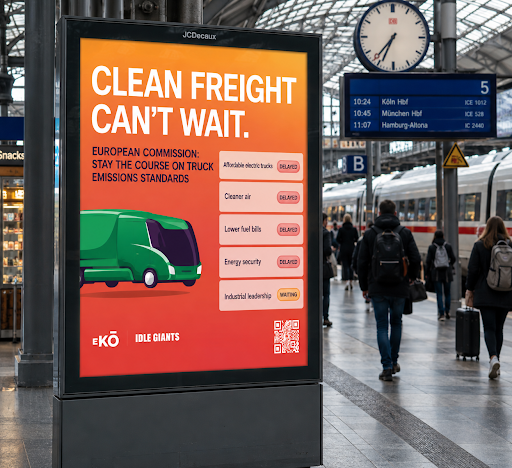
Billboards in Hannover Central Station, welcoming visitors to IAA Transportation, carry a simple message–”Clean Freight Can’t Wait.” The campaign comes just months after the EU amended its 2030 truck CO₂ standards, reducing the target by a quarter following lobbying from manufacturers including Volvo Group and Daimler Truck. Clean transport advocates say Europe has already provided the flexibility the industry asked for and should resist further attempts to reopen the rules.
Under the current EU standards, truckmakers must cut CO₂ emissions from new heavy-duty vehicles by 45% by 2030 and 90% by 2040, with a formal review already scheduled for 2027.
“Weakening the standards again would come at a cost Europe cannot afford,” said Eoin Dubsky, a campaigner for Ekō,“Europe has already delivered the policy certainty manufacturers asked for. Now it’s time for them to deliver the trucks.”
Campaigners warn that every delay to the transition means more diesel trucks on Europe’s roads, leaving Europe to pay the price through continued dependence on imported oil, higher fuel costs for freight operators and the health impacts of air pollution.
Meeting the 2030 targets prevents the sale of ~60,000 additional diesel trucks–avoiding pollution equivalent to putting two million extra cars on European roads and it saves public resources otherwise spent on the health costs of diesel pollution.
“The IAA shows strong momentum for electric trucks, and charging infrastructure is now expanding rapidly as well. The right response is to accelerate this build-out and fleet renewal – not weaken CO₂ standards. That would not add a single charger; it would only slow the market and give global competitors more time to pull ahead,” said Merlin Jonack, Project Lead Heavy-Duty Vehicle Decarbonisation, NABU.
Europe’s CO₂ standards are already driving progress. Electric truck registrations increased by more than 50% in the first year the standards took effect. At the same time, Transport & Environment reports that truck manufacturers continue to favour shareholder payouts over investing in the zero-emission transition.
The CO₂ standards are helping to change those incentives by requiring manufacturers to accelerate investment and deployment. Daimler Truck, for example, tripled its share of zero-emission vehicles within a single reporting period when a CO₂ target applied.
Weakening the rules again would slow investment, prolong Europe’s dependence on fossil fuels and reward delay at the very moment Europe needs manufacturers to accelerate production.
“We cannot keep moving the goalposts every time the industry asks,” Dubsky added. “Manufacturers asked for flexibility and got it. The time for renegotiation is over. It’s time to deliver the electric trucks that businesses, drivers and communities are waiting for.”
NOTES TO EDITORS
Eoin Dubsky (+31)641636410 [email protected]
